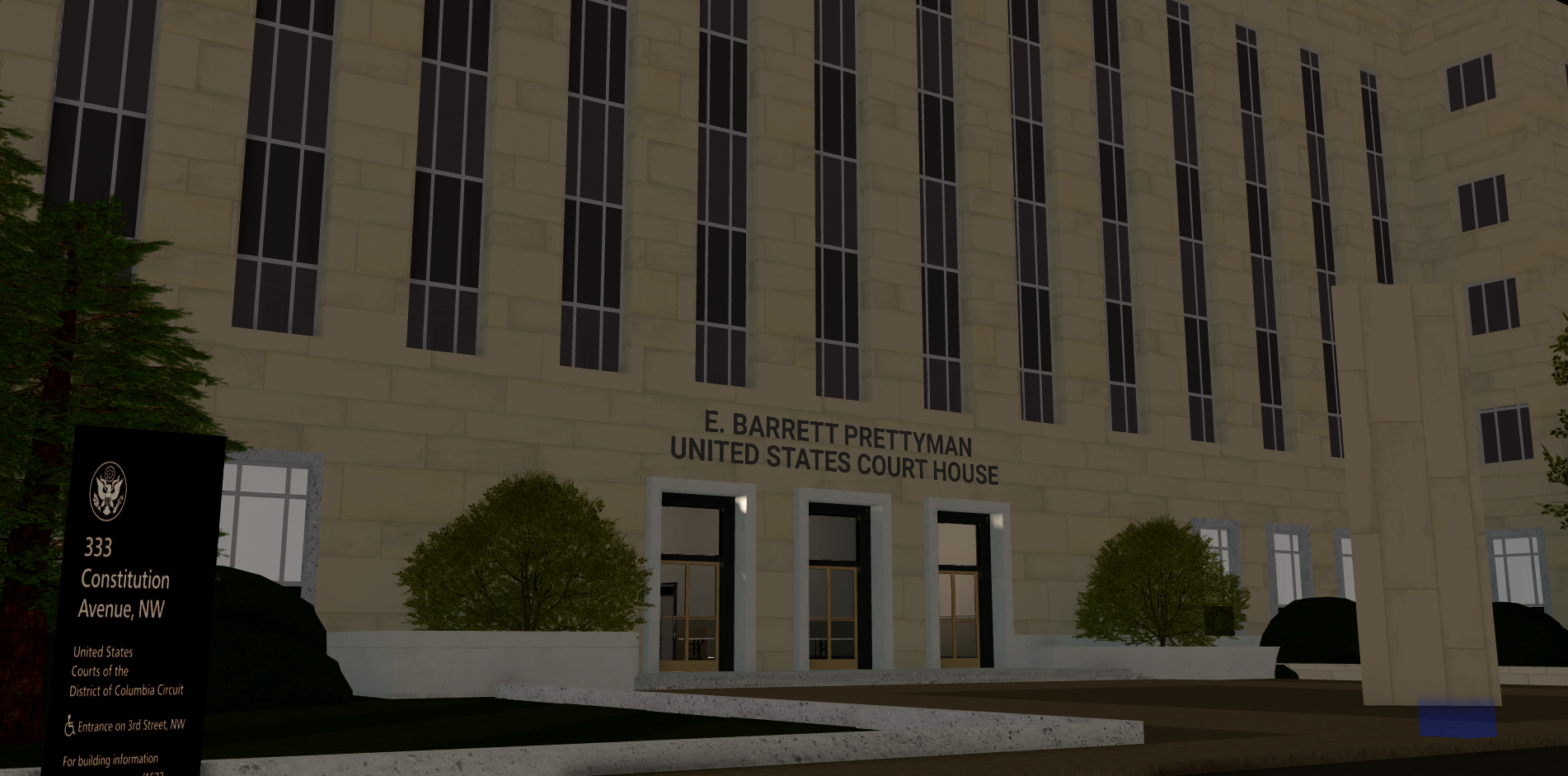
A Supreme Court Justice sitting by designation in a federal district court has issued a criminal contempt order against a sitting United States District Judge of that same court, not for disrupting proceedings or defying a judicial command, but for filing a motion and sending a message to the Chief Judge. The order, signed by Justice notsfeelings in his capacity as a designated judge of the United States District Court for the District of Columbia, arrived within hours of both parties to the underlying case jointly requesting his removal from the matter. Judge BellaRevelation, Hon. Florence Allen, has responded with a detailed motion to dismiss that calls the order what the record, she argues, plainly shows it to be: retaliation.
The procedural setting is itself unusual. Justice notsfeelings is not presiding over this matter as a member of the Supreme Court. He is exercising the authority of a district court judge, assigned to the case pursuant to the Supreme Court Judicial Assistance Act. That distinction matters: the contempt order he has issued is a district court order, subject to appellate review in the ordinary course. It is from that same district court that BellaRevelation is now seeking dismissal, while simultaneously asking the full Supreme Court to exercise supervisory authority over the conduct of one of its own members acting below.
The contempt proceeding, styled In re BellaRevelation, Case No. 1:26-CR-0259, arises from a broader and highly unusual dispute. Judge BellaRevelation is herself the plaintiff in Case No. 1:26-CV-0034, in which she challenges four articles of impeachment introduced against her in the House of Representatives by Representative roleplayersixrp6. Every article of impeachment is premised solely on her public commentary on pending legislation. Not one article alleges corruption, criminal conduct, abuse of judicial power, or harm to a litigant.
Court Document, Case No. 1:26-CR-0259 · US District Court, District of Columbia
Order to Show Cause, In re BellaRevelation
"BellaRevelation engaged in ex parte communications with the Chief Judge, continuing to provide support for her now-denied motion and arguing for why it should be granted... This conduct constitutes misbehaviour of an officer in their official transactions and disobedience to the lawful rules of the Courts."
The timeline the record tells
The factual sequence documented in BellaRevelation's response is, if accurate, striking in its clarity. The matter was fully briefed in Case No. 1:26-CV-0034 as of 20 May 2026. From that date, Justice Feelings, acting as the designated district court judge, entered no ruling, issued no order, and provided no scheduling direction for seven days while, her response notes, sending no fewer than 96 messages in the Discord general chat unrelated to the proceedings before him.
17 May 2026
BellaRevelation files Case No. 1:26-CV-0034 challenging impeachment articles. TRO hearing held same evening. Justice Feelings, sitting by designation, denies TRO but finds two of four Winter factors favor Bella, reserving right to revisit if impeachment becomes imminent.
20 May 2026
Matter fully briefed and ready for decision. No further submissions pending. No ruling entered.
21 May 2026
Bella makes good-faith status inquiry. Justice Feelings responds it will take "a couple of days." Two days pass. No ruling issued.
23 May 2026
Second good-faith inquiry made. No response received. No ruling issued.
25 May 2026
Motion to Expedite Ruling filed, with no response within 48 hours. Motion for Reassignment separately filed with the Chief Judge of the District Court. Chief Judge denies reassignment but acknowledges indefinite inaction is unacceptable and points toward supervisory appellate relief.
27 May 2026, morning
Defendants file a concurrence joining Bella's reassignment request. Both parties now jointly seek Justice Feelings' removal from the case. Justice Feelings interjects into the case chat to announce there will be no reassignment, noting the parties had "ruffled some feathers."
27 May 2026, same day
Bella sends the Chief Judge evidence of Justice Feelings' 96 external platform messages during the period of inaction, asking a single question. Chief Judge forwards the communication to Justice Feelings. Justice Feelings issues the Order to Show Cause within hours. Trial set for 29 May 2026.
"The justice who could not find time to rule on a fully briefed constitutional motion for seven days found time within hours to draft, sign, and issue a criminal contempt order against the judge whose case he has been sitting on in silence."
BellaRevelation's Response to Order to Show Cause, 27 May 2026
The memorandum opinion: the underlying case moves forward
Also on 27 May, Justice Feelings issued a ruling on the merits of the underlying civil case, denying the defendant's motion to dismiss in full. The memorandum opinion in BellaRevelation v. roleplayersixrp6 held that the political question doctrine did not bar judicial review of the impeachment articles, consistent with established precedent holding that impeachment is open to scrutiny when it does not conform to the "good behaviour" standard of Article III. The defendant was ordered to file a responsive pleading by 11:59pm on 31 May 2026.
Court Document, Case No. 1:26-CV-0034 · US District Court, District of Columbia
Memorandum Opinion and Order, BellaRevelation v. roleplayersixrp6
Motion to dismiss DENIED in full. Defendant ordered to file responsive pleading by 11:59pm Eastern, Sunday 31 May 2026.
The timing of that ruling, produced on the same day as the contempt order after seven days of complete silence on a fully briefed motion, is itself a pillar of BellaRevelation's retaliation argument. The designated judge who could not act on a constitutional motion for a week managed to issue both a contempt charge and a merits ruling on the day his removal was jointly requested by both parties to the case he was designated to hear.
BellaRevelation's response: four grounds for dismissal
Filed the same day as the Order to Show Cause, BellaRevelation's response runs across nine substantive sections and advances four principal grounds for dismissal: the factual predicate of the order is false; the legal predicate does not exist; the order is retaliatory on the face of the record; and filing motions and contacting the Chief Judge cannot constitute contempt under any recognised legal standard.
On the factual question, she argues the order mischaracterises her communication with the Chief Judge as continued advocacy for her denied reassignment motion. In her account, she provided the Chief Judge, acting in his administrative capacity over the court's docket and not as a presiding judge in the case, with factual evidence of Justice Feelings' external platform activity during the period of inaction, and asked a single question about that evidence. That, she submits, is participation in an administrative process, not ex parte advocacy on a pending motion.
On the legal question, she argues there is no rule in this jurisdiction prohibiting a party from communicating with the administrative head of a court about administrative matters pending before that administrative head. The ex parte communication rules govern communications with the presiding judge about a pending case, not communications with the Chief Judge in his administrative capacity about a reassignment motion directed exclusively to him. Crucially, she notes, the Order to Show Cause cites no such rule, because no such rule exists.
"A contempt order that rests on a legal theory with no basis in any applicable rule cannot stand. The contempt power does not exist to punish sitting judges for filing motions in their own cases."
BellaRevelation's Response to Order to Show Cause, 27 May 2026
Her requested relief is fourfold: dismissal of the contempt proceeding in its entirety; a finding on the record that the order constitutes a retaliatory exercise of the contempt power; referral of both underlying cases to the full Supreme Court for supervisory review of the conduct of one of its members acting in a designated capacity; and referral of Justice Feelings' conduct to the appropriate judicial conduct authority.
Analysis: vulnerabilities in the response
The response is legally thorough and rhetorically forceful. The timeline argument is difficult to rebut on its face. However, several elements are open to challenge.
Vulnerabilities in the Response, RTÉ News Analysis
Item 01, The Discord Commentary Problem
BellaRevelation's entire underlying case rests on the premise that her public commentary on legislation is protected speech that cannot validly ground an impeachment. Yet that same commentary, made publicly on the rxUSA Discord server while the Senate debated S. 1714, included candid and at times profane remarks about judicial regulation, made while she sits as an active federal judge. The response never addresses this directly. A prosecution contesting her standing or challenging the broader narrative has material here that the response leaves entirely unaddressed.
Item 02, The Administrative Communication Line Is Thin
Her core legal argument depends on a clean separation between the Chief Judge's administrative role and his role in the case. But the Chief Judge did not treat the communication as purely administrative, and he forwarded it directly to Justice Feelings. That act is double-edged: while she uses it to establish the contempt order's suspicious timing, it simultaneously suggests the Chief Judge viewed the communication as sufficiently case-adjacent to route to the presiding justice. That gap the response does not close.
Item 03, Contradictory Posture: Dismissal and Supervisory Referral Simultaneously
The response asks the same court that issued the order to both dismiss it and refer the matter to the full Supreme Court for supervisory review. These requests are not legally incompatible, but they create an awkward posture: she is simultaneously asking Justice Feelings' designated court to rule in her favour and signalling that she does not expect it to do so fairly.
What happens next
The contempt trial is scheduled for Friday, 29 May 2026 at 9:00pm Eastern time. The Attorney General has until 5:00pm on 28 May to appoint a prosecutor or indicate a refusal to do so. Should the Attorney General decline to prosecute, itself a significant institutional signal, the proceeding's future becomes unclear.
BellaRevelation's request for referral to the full Supreme Court raises a question the response does not resolve: how the Court would handle supervisory review of the conduct of one of its own members acting in a designated capacity in a lower court. The recusal implications alone may define the next phase of what has become one of the more constitutionally layered proceedings in recent memory.
← Back to RTÉ World